Stinson’s Venerable “Flying Jeep”
A Short History of the L-5 and its Development

INTRODUCTION
The Stinson L-5 Sentinel is a two-place liaison airplane that was designed in 1941 shortly before America’s entry into World War II. Procured by the U.S. Army Air Forces and primarily assigned to 32-plane liaison squadrons, it was also used by the U.S. Army Ground Forces, Marine Corps, and British Royal Air Force in small numbers. Mainly deployed to Europe, the China-Burma-India (CBI) theater, New Guinea, the Philippines, and various Pacific islands, Sentinels also saw limited service in Alaska, South America, Central America, and the Caribbean. The L-5 was also operated extensively throughout the continental United States, of course.
The unarmed L-5 was designed specifically for artillery observation, Army staff transport, and courier work. However, after entering service in January 1943 the “Flying Jeep”, as Stinson christened it, was widely used for other purposes, including short-range reconnaissance, aerial photography, medical evacuation, search & rescue, and delivering supplies. After air superiority was established in the combat areas where the L-5 operated, it sometimes performed those missions behind enemy lines, particularly in the CBI Theater and the Philippine Islands. It was also employed for controlling troop movements, checking camouflage, dropping leaflets, laying telephone wire, and directing fighter bombers on “horsefly” close air support missions. In a few isolated cases, it made aerial attacks using rockets, bazookas, hand grenades, and other small explosives. Its utility on the battlefield was only limited by the willingness of using organizations to attempt new things.
In the United States, L-5s served in liaison and training roles but they were rarely used for primary training. Not designed with dual instruction in mind, it was utilized for advanced training where liaison pilots gained valuable real-world experience in coordinated exercises with ground forces. Sentinels also aided in training radio and radar operators, anti-aircraft gunners, and air-evacuation personnel. The experimental development of new equipment and tactics was another common use of the versatile plane.
DESIGN
Unlike the other two-seat liaison types that were civilian airplanes purchased more or less “off the shelf” and used for artillery spotting and primary flight training, the L-5 was purpose-built and designed to meet stringent Army-Navy Engineering Handbook standards instead of the less rigorous Civil Aeronautics Authority (CAA) requirements. The only other American plane of World War II that was designed specifically for the liaison and short-range observation role was the O-49 / L-1 Vigilant, also manufactured by Stinson. The Sentinel was created as a cheaper alternative to that much larger, more complex, and far more expensive airplane, which is pictured below.

The roots of the L-5 design can be loosely traced to the 1939 Stinson 105 (aka HW-75), and the follow-on Model 10 that was introduced in 1940. Six stock Model 10s were tested by the Air Corps under the designation YO-54 but, contrary to popular opinion, this type was not simply modified and accepted as the L-5. The Sentinel was an all-new aircraft engineered from the ground up and it only shared some of the basic features of the civilian design. Another common misbelief is that the Stinson 105 and Model 10 were all called Voyagers. That is not true – only the 1941 Stinson 10A, and the post-war 108 series, carried the Voyager name.

Before the YO-54s were delivered in August of 1940, an experimental 100-horsepower, tandem-seat version of the Model 10 was created that better matched military requirements. Originally called the Model 75B, and later designated Model 75C with a 125 hp engine installed, it first flew in June 1940. Although it looked a lot like the L-5 that came along a year later, the similarity was only skin deep. Although this “militarized” Model 10 was a much better performer than the 65-horsepower “grasshoppers” built by Aeronca, Piper, and Taylorcraft that were adopted “off the shelf” by the Field Artillery in 1942, when it was demonstrated to the military in 1940, the Model 75C was ironically not considered rugged enough for combat use. Undeterred, Stinson went back to the drawing board to create a new plane that would satisfy current military requirements.

In 1941, Stinson introduced a second prototype known as the Model 76. While it featured the same airfoil and similar types of slotted flaps, fixed wing slots, and cantilevered main landing gear used on the V-75B/C and its civilian counterparts, those components were enlarged and greatly strengthened. The rest of the airframe was a clean-sheet design fitted with a new 185-hp Lycoming six-cylinder engine that was specifically created for it. Structurally, the Model 76 was in a league of its own and able to withstand more than twice the g-loads that its predecessors or planes from competing manufacturers could handle. Except for the empennage, which was eventually redesigned too, none of its components were interchangeable with the earlier Stinson planes other than basic hardware.

Designed by Athanas P. Fontaine, Chief Engineer at Stinson, with assistance from aerodynamics expert Peter Altman, Dean of the Aeronautics Department at the University of Detroit, the new Model 76 was test flown on June 28, 1941. After minor changes, it underwent accelerated service testing with the newly-created Army Air Forces in August and September. Garnering a tentative manufacturing contract under the designation O-62 just days before the Japanese surprise attack on Pearl Harbor, the first production models did not begin rolling off the assembly line in Wayne, Michigan until November 1942. By then, the designation had already been changed to L-5. The long delay in production was caused by an aluminum shortage that necessitated a redesign of the wings using plywood and spruce as a substitute, and then training workers and re-tooling the assembly line to accommodate the changes.
CONSTRUCTION DETAILS
All L-5 production models had wooden wings, empennage, and doors covered in cotton fabric finished with butyrate dope. The fuselage was constructed using heavy-wall chrome-moly steel tubing also covered in cotton fabric. Early wing struts were steel but later ones, beginning in 1944, were made from aluminum. Up until that time the factory was forced to minimize the use of aluminum which was in short supply and prioritized for fighters, bombers, and advanced trainers.
The 1942 redesign of the wings and tail that delayed production for almost eleven months not only released strategic materials for use on other aircraft being manufactured by Vultee, but clever engineering in wood exceeded their original strength as aluminum components. Designed to meet a military requirement for the airframe to withstand the strain of repeated 6g pullouts from steep dives — far more than any of the civilian planes adapted for liaison work could handle — the wooden L-5 wings were shown capable of sustaining a stunning +14g’s during static testing at Wright Field. That topped the design strength of the Douglas SBD dive bomber wings and is greater than the stress limits of modern aerobatic airplanes such as the Pitts S-2 biplane.

The Sentinel was a stout little bird in every other aspect too, but the penalty was increased weight, greater takeoff and landing distances, and a lower climb rate compared to the Model 76 prototype that had so impressed the military in 1941. However, the trade-off in performance for strength gave the L-5 unrivaled agility. Pilots loved its ability to perform evasive maneuvers that the comparatively frail L-4 Cubs and other liaison aircraft couldn’t manage without risking structural failure. It was also more survivable in a crash due to the heavy construction, particularly so once 4-point restraint harnesses were adopted.
The landing gear of the L-5 was fairly robust, being designed to withstand a 10g vertical drop. The tapered tubular main landing gear legs were damped with long-stroke oleo shock absorbers and the steerable tailwheel assembly was supported on a trailing arm damped with an oleo strut incorporating a coil-over spring. This gave the Sentinel the ability to absorb bone-jarring rough-field landings without back-breaking results. Unfortunately, its Achilles Heel was that the main gear legs were not as resistant to horizontal sheering forces as they were to vertical loads, so many a gear leg collapsed after tangling with an unseen gully, drainage ditch, shell hole, or berm. Once damaged in this way, field repairs were difficult to make so many L-5’s were written off after such mishaps even though they had no other serious damage.
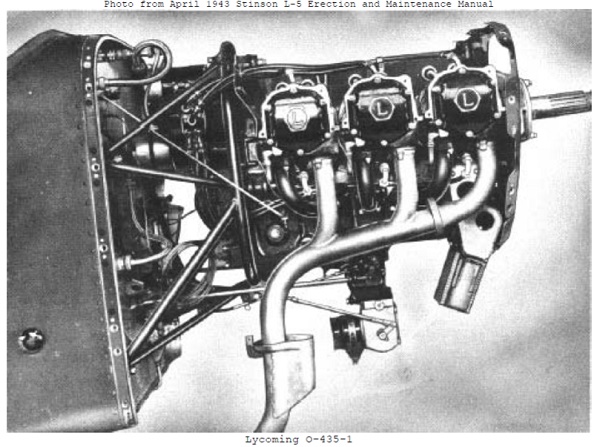
LYCOMING O-435 ENGINE
The six-cylinder Lycoming O-435 engine that powered the L-5 had no such frailties. Producing 185 horsepower (190 hp in the L-5G), it was designed in 1941 specifically for Stinson’s prototype Model 76. This powerplant became renowned among mechanics for longevity under combat conditions, and with minimal care it routinely flew more than twice as many hours between overhauls as the 65 horsepower four-cylinder Continental engines used on the Piper L-4 Cub, giving the L-5 a substantially higher in-service ratio. The power of the O-435 gave the Sentinel other advantages over the Cub such as the ability to operate from high-elevation airstrips while still carrying an observer and a full complement of radio equipment.
Reliability was also a key factor and pilots implicitly trusted the O-435 to carry them over long stretches of water, jungle, and mountainous terrain. As long as an adequate supply of fuel was assured, the rather thirsty (10-12 gph) O-435 rarely missed a beat. In one instance, using auxiliary fuel tanks placed in their ambulance compartments, a squadron of L-5B’s flew from northern Luzon to Okinawa, a distance of 750 miles over water – an amazing feat for a group of so-called “puddle-jumpers”. That speaks volumes of the confidence placed in the big, low-compression O-435.
The biggest enemy of the O-435 is carburetor ice which is something all normally aspirated aircraft piston engines are susceptible to under the right atmospheric conditions. Enough L-5s suffered forced landings due to carburetor icing within the first few months of their release to operational units in early 1943 that the use of carburetor heat was mandated for all flight regimes except takeoff when the ambient temperature was below 68 degrees F. A bigger complaint from pilots, however, was the lack of cockpit heat which, rather oddly, was not among the original military design specifications. Some planes were modified in service with heat exchangers mounted to the port exhaust manifold, but the result was less than satisfactory, especially for the rear passenger.

PRODUCTION TOTALS and VARIANTS
Exactly 3,590 Sentinels were delivered under contract by the end of World War II and another 35 to 45 more undelivered planes were finished and sold on the civilian market in 1946 and 1947. Altogether, six sub-models were manufactured in two basic styles. The original configuration, shown above, featured a wrap-around “greenhouse” that was designed with artillery spotting in mind. Exactly 1,813 of these “observer” type airplanes were produced under the Army designation L-5, Navy designation OY-1, and RAF name Sentinel I.
A substantial factory modification of the fuselage was implemented in early 1944, featuring a large two-piece rear door allowing a stretcher-bound patient or 250 pounds of cargo to be quickly and easily loaded. The ambulance/cargo version pictured below was produced in five variants including 712 L-5B’s, 200 L-5C’s, 500 L-5E’s, 250 L-5E-1’s, and 115 L-5G’s. The utility provided by the cavernous new box-like fuselage was especially useful in the campaigns fought on Okinawa, Iwo Jima, the Philippine Islands, and the CBI theater. However, a more restricted view to the rear made it less desirable for artillery spotting and somewhat more vulnerable to hostile aircraft approaching from behind, but the advantages far outweighed these handicaps.

The first production L-5B, christened Sentinel II by the British, rolled off the assembly line in June 1944. The C-model came along in January 1945 and included a mount for a K-20 aerial camera (but not the camera itself). The E-model premiered in February of 1945 and saw the addition of manually drooping ailerons for improved low-speed handling and slightly shorter takeoffs and landings. The L-5E-1 received larger wheels, tires, and heavy-duty brake drums starting in late May. They aided in operations on soft or rutted ground and improved the stopping distance by 10-20%. Appearing in July 1945, the L-5G featured a 24-volt electrical system that standardized it with most other military planes. All the previous models had been fitted with 12-volt electrical systems. The G-model also had an improved carburetor and air induction system that increased the engine output from 185 to 190 hp while reducing fuel consumption by an average 1.5 gallons per hour. None of the L-5G’s (called OY-2’s by the Navy) entered service before the war ended, but six years later many of them were used in the Korean conflict.

PERFORMANCE
By modern civil lightplane standards, other than its ability to maintain an extremely nose-high attitude without stalling, the performance of the L-5 is considered average and unimpressive, but during World War II it was deemed very respectable. Nominally capable of operating from a 600-foot long dry sod runway at maximum gross weight, when less heavily laden it could easily cope with half that distance when in competent hands. However, faced with a takeoff over a 50-foot obstacle from a rough, unpaved runway, 800 to 1,000 feet was considered the minimum safe length for daily operations. On soggy ground or in deep grass when heavily loaded, the takeoff distance could exceed 1,500 feet to clear a 50-foot obstacle so, in that instance, the lightweight L-4 Cub was often superior for getting airborne more quickly. Due to its lower mass, the Cub was also easier to stop when landing on icy or muddy short strips where braking was poor. Overall, however, the L-5 “Flying Jeep” was vastly superior to the Cub and other “grasshoppers” and, given a choice, many pilots preferred it.

The L-5 held some distinct advantages. It could climb at a sustained high angle of attack and virtually hang on it’s 7-foot propeller in slow flight without stalling. It was also highly resistant to spinning, making it unusually safe for low-altitude, slow-speed maneuvers. With its big slotted flaps lowered 45 degrees it could drop over an obstacle into a short strip in an impressively steep power approach without having to side-slip. On a dry, packed surface, its hydraulic brakes allowed the L-5 to stop in as little as 150 feet with no headwind. These are some of the capabilities that gave the L-5 its legendary but somewhat overrated notoriety as a STOL airplane. While its short-field performance couldn’t compare to the utterly amazing Stinson O-49 / L-1 that it replaced (production ended in 1942 and was later regretted by many), the Sentinel was considered an acceptable alternative to the larger, far more expensive and more complicated no-compromise Vigilant.
All things considered, the “Flying Jeep” exceeded expectations in its appointed roles, and its reputation as a sturdy, reliable workhorse was well-deserved. Sadly, it is not as well-remembered as it could be, perhaps because there are so few survivors today and those who flew them in wartime are mostly gone now.
© 2022 James H. Gray / SOPA