Main Page › Forums › L-5 History Forum › Beer, Bavaria, L-Birds and October
Tagged: L-5 History
- This topic has 2 replies, 2 voices, and was last updated 3 years, 10 months ago by
admin.
-
AuthorPosts
-
-
2022-10-19 at 2:40 pm #5971
Beer, Bavaria, L-Birds, and October? No, sorry, this is not an invitation to a fly-in Oktoberfest party, although that’s certainly not a bad idea! Instead, as most of you have come to expect from me, this is another HISTORY lesson involving the L-5 Sentinel, but I’ll try to keep it short so you don’t nod off in case you’ve been drinking a lot of beer today!
In fact, therein lies the first connection: beer. My fridge happens to be freshly stocked with a brand called Erdinger, a Weissbier made in the heart of Bavaria which is, of course, the epicenter of Oktoberfest. Erding, where the brewery is located, is just a few kilometers northeast of München (Munich), and there probably isn’t a U.S. Air Force veteran who was based in that area between 1945 and 1990 that does not remember Erdinger beer.
The airfield at Erding was the main supply point in Europe for American liaison aircraft after World War Two through the end of the war in Vietnam in 1975. The Air Depot there stocked parts, assembled and maintained liaison (and other) aircraft, and also disassembled them for salvage and reclamation. There probably isn’t a vintage American-built “L-bird” in Europe that was left behind after the war or imported through the 1960’s that didn’t visit Erding or receive a replacement part that came from there. Any current European owner of an L-4, L-5, L-16, L-17, L-19 or L-21 will probably find Erding listed on their Air Force history card, and pretty much all of the latter three types were assembled from crates shipped there from the United States.
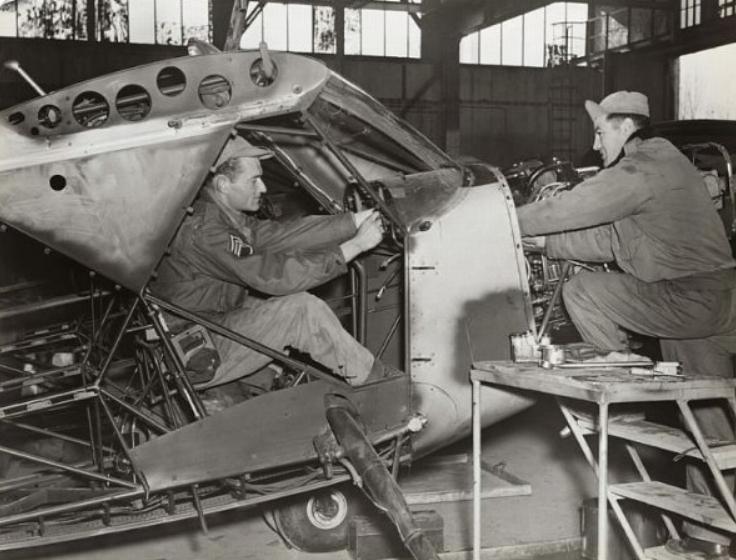
There is also a good chance that if a salvaged or surplus part was used in its maintenance, your L-bird will bear a tag stamped with EAD, for Erding Air Depot. I have an L-5 flap marked Erding, and there are two current L-5 owners in the USA whose planes were at Erding and later came back from there. All of the Army ground forces units in Germany, including the Constabulary, had their light aircraft serviced there. I have not been to Erding myself, but through my Stinson L-5 research, I’m well aware of the activities that went on there. In fact, on today’s date (October 19) in 1949, twenty-three L-5s, along with a similar number of Piper L-4s, were written off the books and laid to rest at Erding as their final reclamation was completed.
Two other quick facts. The airfield at Oberpfaffenhofen was the main aircraft storage and dispersal facility in Germany after WWII and nearly every surplus L-4 and L-5 in Europe went there after the war. If you see “Oberpfaf” or something similar on a USAF record card, that’s what it refers to. Located a little southwest of Munich, just 50 kilometers from Erding, the two bases worked together to supply and maintain most of the U.S.-operated liaison aircraft based in western Europe. Also, Erding was where the first flights of the Berlin Airlift departed from, and the airfield was home to both USAF and/or Luftwaffe air transport Wings from 1948 up until its closure in 2018. If you happen to fly into the Munich International Airport, look 10 kilometers to the east-southeast and you’ll spot the history-laden runway at Erding.
So, if you’re inclined to grab a “cold one” and do some “elbow-bending” this month in celebration of Oktoberfest, be sure to toast the Piper, Aeronca, Stinson, Ryan and Cessna liaison airplanes of yesteryear that passed through Erding. If you do it with an Erdinger, so much the better. Salute!
PHOTO: L-5 at Erding, 85th Air Depot Wing, 1949.
-
2022-10-20 at 6:02 am #5979
Great photo! Unheated hangar ( door open in background). I like the boot cowl paint:) Looks like plane was original green (of course) and still has that paint on section under the windshield. Then repainted silver (very light color area on sides) and black anti glare panel just visible at top section. But what has my attention is the newly sprayed Green on section of side boot cowl and along the edges of the side window and the wood rib around the gear leg. Also you can see the original outline of the wing (in green) at the root rib and the silver outlining it.
So they painted the OD green plane silver with the wings installed. But then? I wonder if they were using left over OD green as primer? ( adding chromate to colored paint? Grumman did this on F6F when they went from Tri-color to glossy blue paint schemes.)
Do you think this L-5 would have been finished in Silver or OD green when it was done?
-
2022-10-20 at 1:51 pm #5980
I think the plane was possibly being dismantled for reclamation. You might be right that they were using OD green as primer. If they were rehabbing it, they would have been sprayed silver again since it was 1949. Either way, a nice find and a good clear shot with some interesting details.
-
-
AuthorPosts


- You must be logged in to reply to this topic.