Main Page › Forums › L-5 Maintenance Forum › Intermittent Running Hot Oil Temp
Tagged: Removed vernatherm today
- This topic has 20 replies, 3 voices, and was last updated 4 years, 8 months ago by
 John Griffin.
-
AuthorPosts
-
-
2021-10-22 at 3:37 pm #4505
Thursday after being down 4 months, I got my L5 back in the air with 2 rebuilt cylinders. The first hour of buzzard practice around the airport the oil temp inched up to 96 degrees celcius. The next flight was less than an hour and it inched up to 95. The next it went to 104 and I landed allowed it to cool for 4 hours then flew again. It went back to 104 and I landed. This has happened before changing the cylinders, but not in 2 flights. Before after cooling down, it would go back to 95. In the past it might do it on 1 in 10 flights. Always keeps me watching oil temp. My mechanic flushed and cleaned the cooler while we waited on the cylinders. I know something is sticking and not allowing oil to the cooler. Point me in the right direction.
Thanks,
John
-
2021-10-23 at 12:04 pm #4506
Hi John,
There could be a several issues, including a lean-running engine, but I’m about to head out the door, so I’ll just ask two simple question s- what was the oil pressure doing, and have you checked the oil screens? I’ll get back to you later with some troubleshooting ideas unless Sam or someone else beats me to it.
Jim
-
2021-10-23 at 4:10 pm #4507
This is a come and go issue. The oil pressure runs 70# at cruise, all the screens are and have been clean. We just changed oil and replace 1 and 3 cylinders. In the first flight, the oil temp went to 95C and the second flight was similar. The third flight went to 105C in about 30 minutes. I allowed it to cool and flew again and it returned to 105C. Today I flew early for a little over and hour and it went to 89C. Later in the afternoon OAT 83F I flew again for a little over and hour and it went to 92C. It was doing this before the cylinder change, not often, but enough to make me nervous on a cross country flight. Reading the O-435-1 rebuild manual and looking at the parts book, it appears there is a spring and plunger on the bottom of the sump by the oil filter line. I’m guessing the plunger is sticking and not allowing oil to the cooler. I have noticed that when the temp is high and I pull power to land, the oil pressure is bouncing more than usual. It has always had a wavering needle on landing, but is more pronounced when it also has high temp. Thinking about pulling the plunger on my shelf engine to see what it all looks like.
John
-
2021-10-23 at 11:17 pm #4508
John,
OK, now I have more time for this and I see that no one else has chimed in yet. After thinking about it off and on all afternoon, I believe you may be right, there could be some sort of blockage to the oil cooler. If it was a more modern engine I’d suspect a faulty Vernatherm (thermostatic bypass valve), but our O-435’s don’t have one of those.
Earlier this evening I checked old emails from people with similar issues and found one from Fred Wright way back in 2012 quoting nearly identical oil temperature numbers – peaking at 105 and dropping to 87 degrees C. Incidentally, he was also breaking in fresh cylinders which always generates more heat than normal. In Fred’s case, it turned out to be a faulty oil cooler causing the problem. Of interest here is that some people in the northern climes bypass the oil cooler intentionally because the oil doesn’t heat up enough.
Anyway, to verify that the oil cooler isn’t doing its job is a simple matter of feeling the cooler and both the inlet and outlet lines shortly after flying, which should be long enough to raise the oil temperature to at least 80 degrees C., if not more. The lines and cooler body should all be about the same temp as the sump, although given the time required to uncowl the engine, the cooler and lines will lose heat more quickly than the sump. If you have one of those digital point-and-shoot infrared thermometers, that could be helpful. It might also avoid potentially blistered fingers. If the oil cooler and lines are significantly cooler than the sump, there’s probably a blockage somewhere.
One possibility that my Lycoming troubleshooting guide mentions is an air bubble trapped in the oil cooler that could be preventing positive flow. I’ve never experienced that with an airplane engine myself, but it’s a common issue I’ve come across with automotive cabin heater cores that don’t seem to get hot even though the rest of the engine is up to temp.
While you’re at it, obtain a long-stemmed high temp kitchen thermometer (metallic, not glass) such as a candy-making type or one that restaurants use for checking deep fryer oil. You can insert it in the dipstick hole and get a direct reading of oil temperature that you can compare to the gauge on your panel. The one I keep in my tool box cost about $20 and the stem is longer than the dipstick. It works nicely for verifying that a gauge isn’t lying to me and it’s more expedient than removing the gauge and bench testing it.
Other than the oil cooler and inlet/outlet lines getting plugged up with sludge, there’s nothing else I can think of than can cause a flow issue that won’t also affect oil pressure. My O-435 knowledge is a little hazy about this next point, but I think the supply side of the oil cooler is directly affected by the oil pressure relief valve. When it is dumping oil back into the sump to relieve excessive pressure, flow through the oil cooler is reduced. So, it occurs to me that maybe the relief valve in your engine isn’t seating properly due to a contaminant of some sort. If that is the case then lower pressure should be indicated by the gauge. This is one of the reasons I asked about oil pressure readings in my earlier quick reply.
That’s all I’ve got. Can anybody else to add to this or refute it? Sam…? Duncan?
-
2021-10-24 at 10:28 am #4512
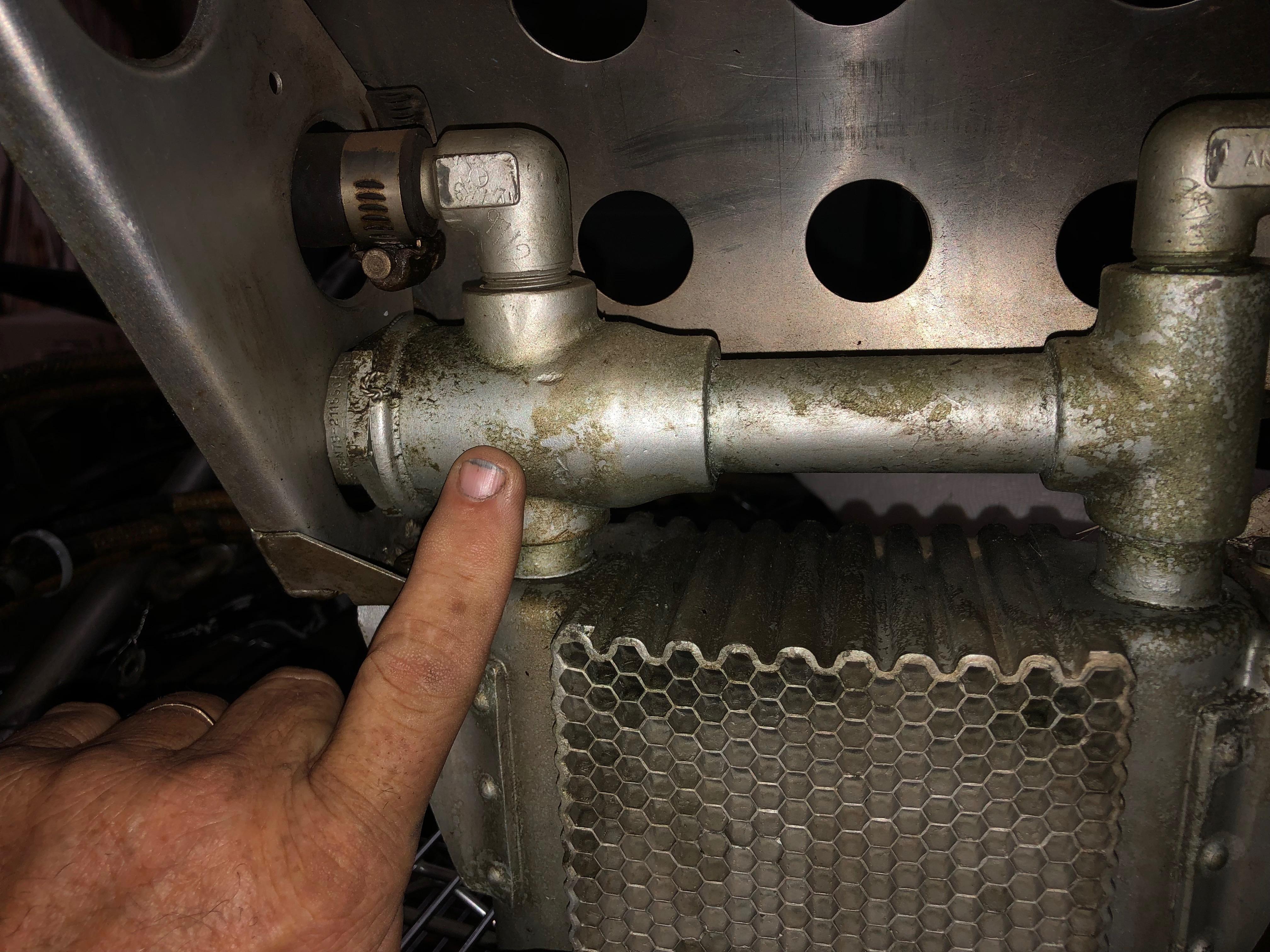
Hi Guys , Sorry I took time away from desk and just found this. Two things come to mind. Oil flow through cooler and oil to the cooler. (1) Our coolers do have a valve in the cooler which I think is a vernatherm ( temp controlled valve which port oil around the core). It may possibly be just a pressure or surge valve which ports cold oil (moving at higher pressure than warm oil) around the cooler core . Either one of these valve types can stick and create a cooler bypass ( or partial bypass). The fix is send cooler out for inspection ( you may be able to send just the vernatherm valve for inspection. Call the cooler shop and ask first). The valve is located in the end of the cross passage tube above the square oil cooler . The shops often nickname these types of coolers ” suitcase coolers” because the have the “handle” on top. The “Handle” being the horizontal cross tube. I think this is the likely problem.
(2) The low oil pressure relief valve is the one John saw in the oil sump near the oil cooler outlet fitting. It will take any oil removed from the oil pressure passage (in order to maintain a minimum low oil pressure ) and run it to the oil sump by way of the oil cooler. If that valve spring pressure is too high it will bypass less oil off for cooling . I would make sure that there are no washers under the spring inside that spring cap.
Note : I installed a remote oil filter in the oil cooler line on my L-5. I mounted it on the firewall . My oil temp is so cool here in the midwest even in summer that I removed my oil cooler from the system (I am lucky to see 82C oil temp).
Let us know …
Sam
-
2021-10-24 at 10:50 am #4514
-
2021-10-24 at 10:52 am #4515
The photo I sent was the oil cooler cross passage “handle”. The valve screws into th send of this passage just to the left of my finger. ( you may be able to see the safety wire securing it)
Sam
-
2021-10-24 at 1:42 pm #4518
Sam and Jim,
Thanks for the input. I did not understand the valve on the cooler but it looks like a good start. I will call Monday to see who can inspect to see if that is the problem. I will also check to see if there are washers under the spring of pressure relief plunger. I thought maybe that was how you adjusted the oil pressure.
John
-
2021-10-24 at 2:04 pm #4519
For oil cooler service I recommend R&E Oil Cooler Services in Prescott Valley, AZ. They have an outstanding national reputation, particularly among warbird and antique aircraft owners, and they are familiar with our honeycomb G&O coolers. They also clean, inspect and service vernatherms. The owner has a hangar near mine at DVT in Phoenix and has stopped in a few times on the rare occasions when we’re both there.
-
2021-10-28 at 2:33 pm #4538
-
2021-10-28 at 2:36 pm #4539
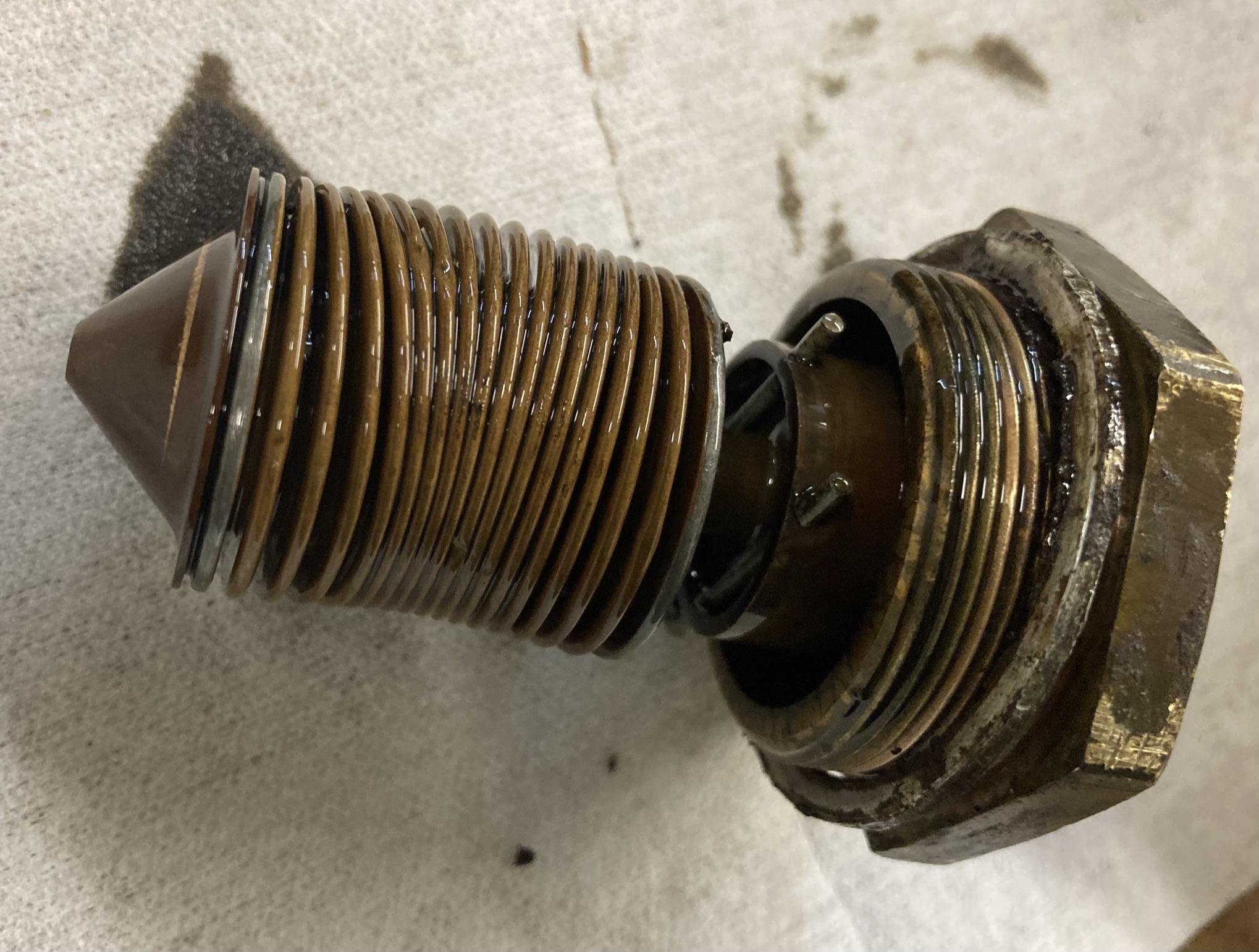
The above picture is the vernatherm from my oil cooler. It is not sealing properly, you can see the scuff mark on the top where it is missing the port. Sending it to R & E coolers for Brian to repair or replace.
-
2021-11-12 at 1:56 pm #4549
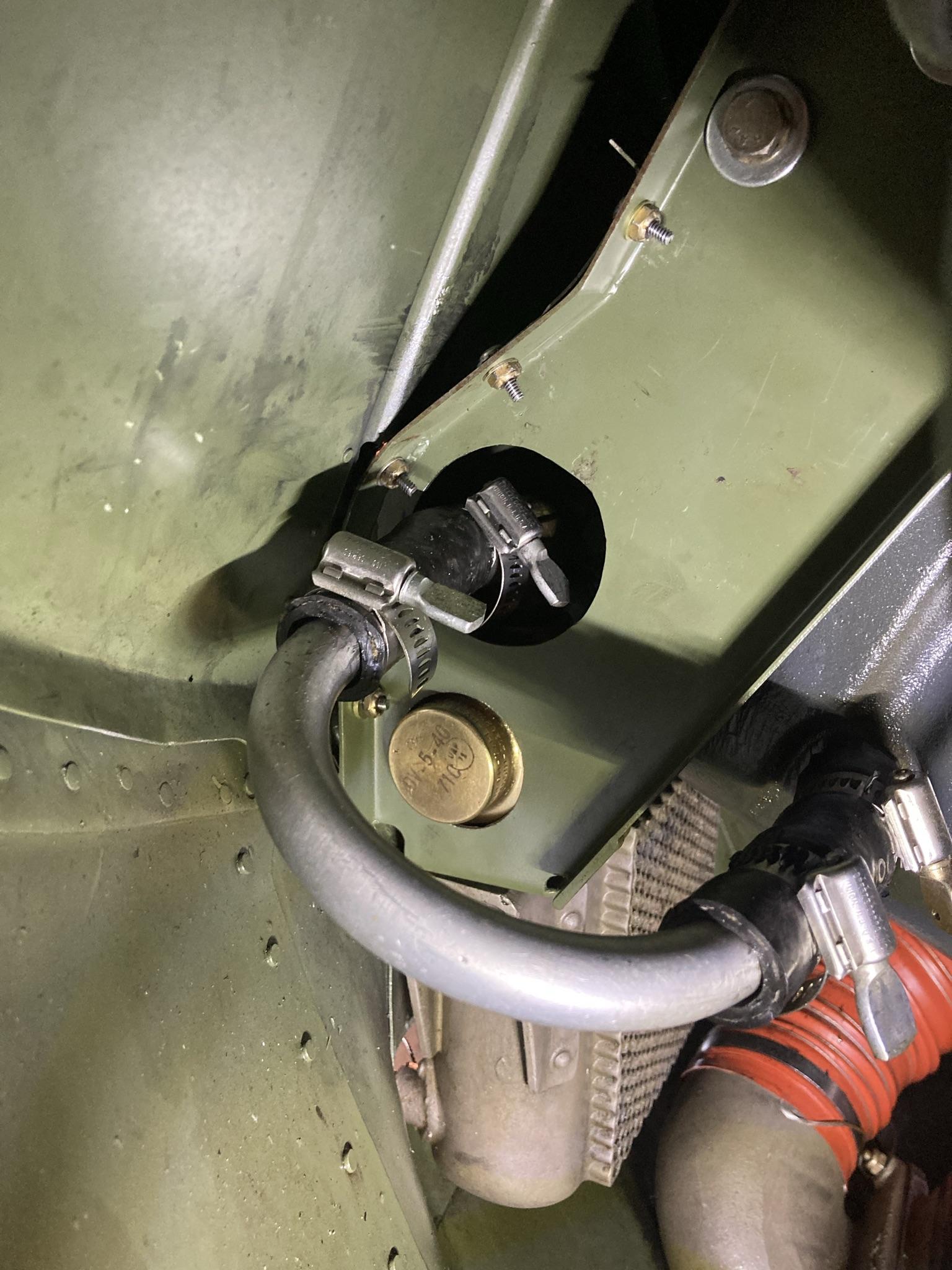
Just an FYI for others who may have vernatherm issues in the future. The “baffle” type that was in my cooler was considered unairworthy years ago according to Brian at R & E Oil Coolers. He found a replacement for me, but I will have to cut a hole in the mounting bracket as the picture from Sam shows on his.
-
2021-11-12 at 7:46 pm #4550
I’m glad that’s sorted John. I’m still embarrassed that I had forgotten there is a vernatherm in the oil cooler even though I had written about it in the past. I did not know about the superseded part because all six of the G&O oil coolers I’ve had in my hands over the years have looked exactly like Sam’s with the hole in the bracket. You’d think that at least one of our members would have run across it in the last 20 years. It just goes to show that no matter how much you tinker with these old birds, scrutinize the manuals, blueprints, service letters etc, there’s always something new to learn.
-
2021-11-18 at 4:44 pm #4551
-
2021-11-18 at 4:53 pm #4552
New vernatherm installed late today. Now it’s time to wash down and runup for leak check and prepare to fly.
-
2021-11-21 at 12:48 pm #4557
OK, latest update on the overheating. Did first flight after replacing vernatherm Saturday. Within 30 minutes it was over 100C. After saying some choice words, I landed and did what Jim suggested and stuck long stem thermometer in the dipstick hole to confirm the temp on the dial was correct. It was. This afternoon I pulled the bypass valve underneath the sump and inspected and cleaned it. There were no washers and it didn’t appear to be dirty. It did appear to be polished more on one side than the other and there was some slight pitting in the top surface, not the sides that are in the plug. If that makes sense. I worked and and spun it in its housing and reinstalled. I then flew for over and hour and the temp moved back and forth between 85 and 88c. I believe I have a sticking bypass valve. I have another O435-1 and a O435-A. I have not checked the part numbers yet but if the A is the same, I will pull it and try it this week. If not I will pull the one from my spare -1. I’ve got to get where I can go places instead of circles near the airport.
-
2021-11-21 at 1:45 pm #4558
As Charlie Brown would say, “Rats”, but I’m glad my method of checking the temp gauge worked for you. Changing the pressure relief valve does seem to be the logical next step. It sounds like it stuck open on your initial start when the oil was cold and the pressure was high and then it stayed that way for the whole first flight, causing low flow through the oil cooler. Then, after you pulled it, cleaned it and rotated the valve, it didn’t stick on the second flight and more oil was diverted through the cooler as it normally should. That seems to explain the intermittent behavior you’ve been getting. I don’t see why the valve from your -A would be any different in design from the -C. I believe the only difference between the two engines is in the accessory section. Good luck with the next attempt.
-
2021-11-21 at 5:09 pm #4559
Jim,
I compared the two parts manuals for the -1 and A and yes they are the same. The plunger, spring, and plug are the same part #s on both engines. I would hope to find some info in the rebuild manual about wear tolerances on the plunger, but have not yet. I will swap them this week and fly again when weather permits.
The long stem cooking thermometer worked great. I found one with 15 inch probe and sliding attachment. I put it down to the same depth as the dipstick and it ran up to 190 PDQ and that’s what was on the temp gauge on the panel.
John
-
2021-11-24 at 9:12 am #4562
More FYI. I pulled the bypass valves from my engine and the 2 spares. If I read the overhaul manual correctly, there is supposed to be 0.0015 to 0.0035 clearance between the cup and the plunger. If it exceed 0.005 it is to be replace. None of the 3 exceeded the 0.005. I was able to to get the best cup and plunger to about 0.002 and compared the springs and found 1 felt slightly stronger than the others.
On first flight I noticed the oil pressure was down maybe 5# to about 68#. It usually ran slightly above 70#, but the temp stayed between 85-88C. Hopefully this will fix my overheating problems. I hope too that if someone else has the same issue, it doesn’t take as long to run it down.
JG
-
2022-01-25 at 8:29 am #4741
Hi John, Really good info!! Any updates?
Sam T
-
2022-01-25 at 5:22 pm #4829
Sam, all seems to be good. I have not put that many hours on it since changing the by pass valves, but I have put a few and oil temps have ranged from 78 to 94c depending on oat. Weather and the new found relationship my wife and I have now found with our doctors in our advancing years has put a squeeze on my flying time. I have put about 20 hours on the new cylinders and have noticed in the last couple hours the oil consumption is going down. Checked compressions and the 2 new cylinders are in the mid 70s and 2 others are in the mid 7os and the other 2 are in the mid 60s.
John
-
-
-
AuthorPosts


- You must be logged in to reply to this topic.