Main Page › Forums › L-5 History Forum › March 14, 1938 – Landmark Event in Liaison Aircraft History
Tagged: Liaison Aircraft History
- This topic has 0 replies, 1 voice, and was last updated 2 years, 7 months ago by
admin.
-
AuthorPosts
-
-
2024-03-14 at 12:29 pm #6540
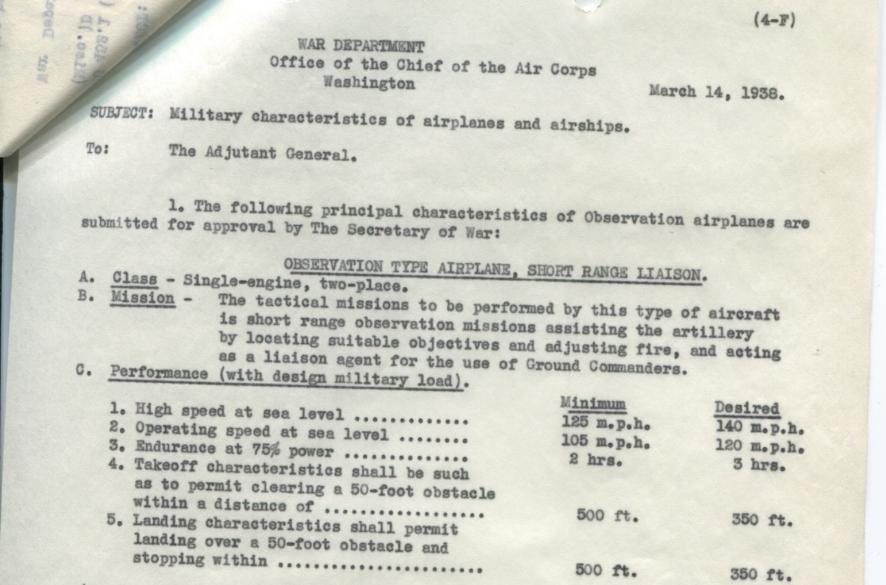
Eighty-six years ago today was an important milestone in the development and adoption of low-speed, unarmed liaison aircraft in the United States. It was on 14 March 1938 that the Adjutant General formally approved the design characteristics recommended by the Material Division at Wright Field for a two-place, single-engine, short-range aircraft for artillery fire control and liaison missions for ground commanders.
In 1946, noted Air Force historian Irving B. Holley wrote that this unheralded decision was a landmark in the evolution of observation airplanes. The performance characteristics for the new type included a speed range from 40 to 125 mph, and an ability to clear 50-foot obstacles in a run of 500 feet or less. Most significantly, the planes were to be UNARMED – an unthinkable proposition up to that time.
Although the concept remained hotly debated, and it would be nearly two years before serious consideration would be given to adopting civilian light planes “off the shelf” for the artillery spotting role, and another year and a half before that became a reality, the wheels making it possible had been set in motion this day in 1938.
As I have written previously (see L-5 History Blog #17), this event and others related to it preceded the demonstration of the Fieseler Fi156 “Storch” at the Cleveland Air Races in September 1938 by many months. Although that event garnered much publicity, it was not the reason that the U.S. military decided to embark on a development program for a similar type of aircraft – a fact that many (if not most) aviation historians have gotten wrong.
Here’s a section of the document approved by the Adjutant General on 14 March, 1938 (scanned by me from the Wright Field files at NARA in 2012). Of interest to L-5 enthusiasts, these figures are precisely what the engineers at Stinson strove to meet with the Sentinel.
-
-
AuthorPosts

- You must be logged in to reply to this topic.