
Forum Replies Created
-
AuthorPosts
-
Charles: Are you hunting the bracket or the switchbox? Be aware on the switchboxes that there are two versions….one for 3 lights and another for 4 lights….
Craig
Charles: Where were they used? I would assume somewhere in one of the doors or the litter decking, based on the cage depth.
Craig
The one I got from Duncan, copied off an original one from a B model, was drilled for the AVA-10 or AVA-53 crystals, which are much larger than the FT-243’s. As the AVA crystals were removed form aircraft going overseas, and replaced in theater with Ft-243’s, they don’t fit due to using different hold spacing and pin diameter.
Speculation here, but I would believe as there were 80 or 90 individual crystals to a complete FT-243 set, that the pilots only pulled the primary two or three crystals for the day and kept them in a shirt pocket.
Hilly: 76-72018 should be the canvas cover for the holder. It shows to be part of the 76-72043 installation. From that drawing, it’s applicable to all the observer models from 76-627 and up. The holder is micarta and a little wider than the crystal, sized to hold 10 crystals, and around 1/2″ thick. I don’t have mine here at the house, but can go over to the warehouse this weekend and get some good measurements for you.
The earlier shelf got superseded by the 72043, probably for ease in manufacturing, as the original one was molded plywood.
Craig
Jim: A side question about your trip to the FAA archives….Did you have to supply your own copying equipment, or did the FAA people do it for you? How rough was the cost at the time… per page or drawing or by whatever was in the complete box?
I’d like to get into the files for a particular TC from the 20’s/30’s and see if some unlocatable drawings are within the TC files or not.
Hilly: The AVT-112 takes both the AVA-10/53 crystals and the FT-243’s via an odd socket. If you choose to go with the FT’s they are readily available down there and inexpensive…..about 5$Aus each. You want to look for ones with the Bakelite cases, as I don’t think the ones with the metal face plates came about until after the war.
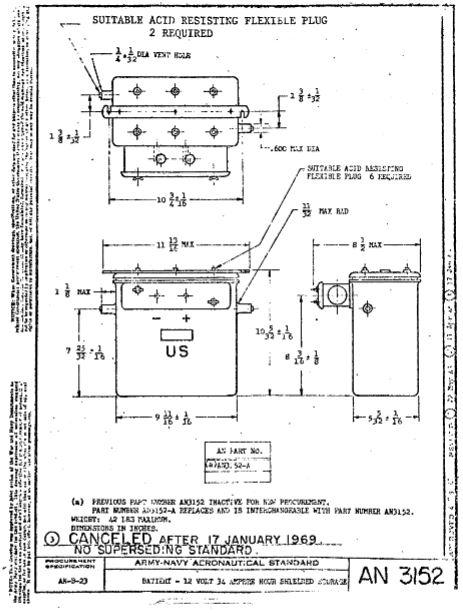
Forgot to add, here’s the spec on the battery:
Hilly: Something that will help you immensely on chasing applicable drawings is to pull the part number from the IPB, then apply the effectivity markings and then go to the drawings.
A quick and easy example;
Go to the page on lift struts in the IPB. If you look at the first set of entries, you will find three part numbers there for the A model. 76-10001-0, 76-10001-1 and 76-10060. Looking to the left of the part number, you will see that there is a cross symbol on all three part numbers and a 2 in front of the cross on 76-10060. Down at the bottom of the page, there is a list of the cross and the number 2, showing what aircraft that part number is effective for. In the case of s/n’s 42-14798 thru 42-99160, the 76-10001 series parts were the original install, and the 76-10060 was used on 42-99160 and on. As the cross is applied to the 76-10060, in means that should one need to replace a lift strut on the early model, the later version of the strut is an acceptable direct replacement.
Where things get complicated, is when there are multiple part numbers and installations and optional configurations. I’ve had some drawings at work, that have as many as 100 effectivity flags to show what airplane gets that particular configuration…..
A friend that works for a different aerospace company from me, came up with a copy of the AN3152 battery. Holy smackers it’s small for what all it powers. Basically it’s 5″x 9″x 11″ tall.
Geoff: When you get to the crystal holder, you will need to decide if you are going to drill for stateside crystals or for those used overseas. Overseas, they switched to the FT-243 style crystals, which are much smaller than the AVA-10 or AVA-53 housings. The AVA’s are also much heavier than the FT-243’s. I’ve got almost a complete set of AVA’s for my airplane, to fill the holder and they weigh about a half pound each. The FT’s are much easier to find and probably weigh about 2 ounces each.
From what I’ve been able to find, the aircraft left the factory with the AVA series crystals, but they were removed and FT-243’s were used once the aircraft got overseas.
If you want to just have fillers for the AVA-10/53’s, I can give you most of the dimensions, other than a couple of radii, and you could 3d print a set and drill for your own banana plugs.
Craig
Geoff: Yep, that’s me. I also added the question over on WIX as well. Jim mentioned Taylor doing one for his G model, but the G’s used a completely different sized battery than all the others.
Did a little cracking of the books this morning and discovered that the AN3152 battery was also used in the OA-10 Catalina. The 3152 is apparently steel cased, with a gasketed lid and provisions for vapor venting and drainage. Electrical terminals are also cased, so no box needed. I think I found a source for the spec, but will have to try tomorrow on gaining access.
Craig
Geoff: I ran thru the IPB and it appears that there never was a battery box for the L-5. It shows that the battery was held in place by the tabs around the shelf it sat on, combined with a cross bar type hold down.
Geoff: Try ClipsAndFasteners on ebay. He’s got boxes of 25 for 19.99 $US, and ships down under.
Matt: Actually looking for the drawing for the Drop bags. A friend has found the drawing for the later and larger version and is going to send a copy. He’s going to see if he can find the drawings for the smaller A-1 as well.
-
AuthorPosts
