
Forum Replies Created
-
AuthorPosts
-
I have copies of the USAAF record cards for all the L-5s Dan. A quick rundown on 42-98289 is as follows: Aug 21, 1943: Accepted by USAAF (as on your data plate). Departed for Alachua AAF, Gainesville, FL on the 23rd. That was the location of the Army Air Forces School of Applied Tactics at that time. After almost a year of unreported activity, in Sept. and Oct. 1944 it is in Texas, bouncing back and forth between the 163d Liaison Squadron at Mineral Wells, TX and the 2619th Air Base Unit at Carswell AAF in Fort Worth. After the 163d leaves for overseas service (Okinawa). it is reassigned to the newly formed 360th Base Training School, Liaison, at Mineral Wells. In January 1945 it was sent to the 360th Base Maintenance Activity at Brownwood AAF, possibly for an engine change, and in April it got transferred to the 349th Base Maintenance Activity at Muskogee where it was prepared for storage. On June 30, 1945, it was transferred to the Reconstruction Finance Corporation (RFC) for disposal. In a nutshell, it spent 20 months in advanced liaison pilot training and field exercises, preparing pilots who had made it through primary and basic training for overseas assignments.
I think the plane was possibly being dismantled for reclamation. You might be right that they were using OD green as primer. If they were rehabbing it, they would have been sprayed silver again since it was 1949. Either way, a nice find and a good clear shot with some interesting details.
Very nice, Hilly. Not many of those wooden rear seats exist in serviceable condition. FYI, there was a mod that cut and hinged the back for easier access to the area behind the seat. Some aircraft had it, some didn’t, but it first came about due to a factory mod that cut the V-braces behind the seat and substituted trusses with clamped supports so that a stretcher could be loaded with the aft end collapsed. There’s a T.O (01-50DB-19) about it and you may have seen photos if you have copies of an older version of the E&M manual or copied it from the ACA website. I’ll try to post some images after they’re loaded onto the website.
JG
I just asked John and he has plenty still available, but that will not necessarily resolve the question of getting a unit overhauled because those NOS gauges should be disassembled and cleaned before use. After 50-75 years in storage, the internal lubrication is undoubtedly gummy. The needles can therefore stick, and at worst the mechanism can be damaged.
Oh, so formal Charles; it’s “Bill” to almost everyone who knows him. Anyway, there are about two dozen L-5E-1 and L-5G Sentinels that are still ostensibly flyable or being rebuilt, and I know of a couple of converts to the larger wheels, but I do not know how many have been converted to Cleveland or other aftermarket wheels and brakes. Certainly a few have. Of those less than two dozen potential takers, not including you and me, there are maybe six owners of those aircraft who are likely to read your post here. So, I’d need to start sending out private emails or snail mail to catch those members who don’t participate online, and you’d have to post on some of the Facebook or CAF forums to attract a little more attention. I’m about to go off traveling for the next 1two weeks, so won’t be able to get to it until next month at the soonest. I think how many might be interested will also depend on whether it is financially viable to make a run of expander tubes, and that’s if there are still enough NOS pucks and hardware to make that worthwhile. I’m all for it, but can’t speak for anyone else. Jim.
-
This reply was modified 4 years ago by
admin.
The military L-5 Inspection Requirements Handbook (AN 01-50DB-6 aka T.O. 1-L5-6) serves as a basis for creating an annual inspection checklist, but on its own, it is inadequate, requires interpretation as to which periodic inspection applies to an
“annual”, and does not address many of the issues we find in our 75+ year-old airplanes. It also lacks illustrations that would be helpful. So, everybody please standby while I re-create the illustrated checklist I put together 15 years ago that got lost in a hard-drive crash. JGInconel/graphite flat and solid ring type compression gaskets are used in exhaust applications, so some of the braided ropes might be ok. There are also fiberglass/inconel rope gaskets used in exhaust applications up to 650 degrees C continuous.
Bill,
Club member Charles Rooks looked into having clamps made and he found someone who will do it, but the minimum order is 6 sets (36 clamps) at an approximate minimum price of $60 each. They of course have to be made under the owner-produced parts reg. You can contact Charles at tcraftdc65 (at) yahoo.com. Maybe we could get enough people interested if you cannot find some originals.
As for the exhaust packing that fits inside the clamp and seals the tubes, the original parts were made from braided Inconel wire and the closest thing is a Cessna 310 turbocharger gasket trimmed to size and the ends whipped together with single-strand Inconel. This is wasteful of material and is also quite expensive., but it’s way cheaper than buying a roll of braided Inconel wire.
The poor man’s solution is this…braided Harley Davidson retrofit exhaust gaskets made by James Gasket Co. They’re currently out of stock at J&P Cycles so you’ll have to hunt for them if you go this route.

These are reported to be a very a tight fit on the O-435 stacks and take some effort to get them into place. They are not made from Inconel so won’t last but a fraction of the time in service. At $5 each or so, you could easily afford to replace them at every annual on your own bird, so someone paying a mechanic for the installation will lose the cost advantage over time.
Here is one viewpoint about using the Harley-type braided gaskets that I published about 12 years ago…
A little “Metallurgy 101” may convince some L-5 owners that stainless or copper braided wire is not the way to go. In most aircraft piston engines, exhaust temperatures range from approximately 500 degrees C. to 750 degrees C. Copper or stainless braided wire doesn’t handle the heat very well above 300 degrees C. Inconel is a high nickel-chromium alloy specifically designed for high heat, high corrosion resistance (exhaust gases are highly corrosive), so it is commonly used for items such as aircraft turbochargers. There are various grades of Inconel that range up to 80 percent nickel. The standard 50/50 stuff can withstand 600 C while the high-grade variety can withstand 750 C.
Interestingly, without chromium and other additions, straight nickel can only withstand about 200 C. Your standard stainless woven wire, on the other hand, only contains about 8% nickel and it loses its rust-resistant properties at high temperatures. The only copper type braided wire that is usable for o-ring type exhaust gaskets is Monel, which is a Copper-Chromium alloy but it is only heat resistant up to 400 degrees C. so isn’t ideal, but it is better than the stainless and copper variety.Jim
Another article indicates that it was an L-19, not the Foss L-5 which doesn’t have U.S. Army on the right wing. .
I saw the headline while surfing the ‘net last night. All I can say is that it’s time to finish the “How not to Groundloop your L-5” article that Sam, Duncan and I started working on a few months ago.

You can buy the 24-volt version but the 12-volt bulbs are “unobtanium” unless the planets are lined up correctly on February 29. There is no modern equivalent. That said, I just spotted one on Etsy for $179 still in the housing that appears to still be for sale. Search “Aircraft GE Mazda Airplane Landing Light”.
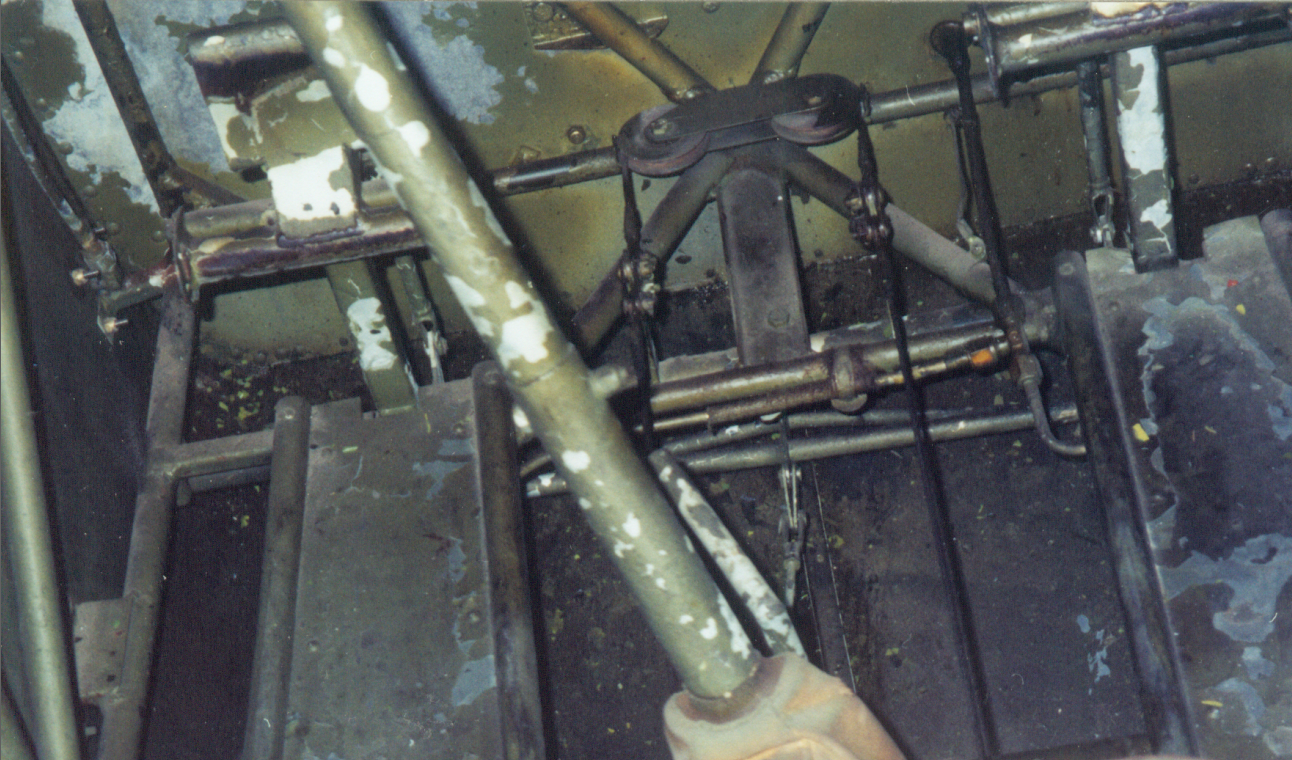
As you’ve probably seen, the blueprints say “SF-76” for the finish spec, and Section VII Finishing Specifications in the Maintenance handbook says that for Interior Alclads (i.e. the pilot’s foot trough plates) get prepped with 1 coat of zinc chromate and 24ST aluminum gets an additional 2 coats of “lacquer of appropriate color”. The mahogany ply bases and half-round maple edges get 2 coats of sealer and 2 coats of “lacquer of appropriate color”. The birch 3/16″ plywood observer footplates and rear floor panels get the same 2 coats of sealer and color. The catch-all in the manual is “paint to match surrounding structure”, which was also variable.
These floorboards were parts made by sub-contractors, however, so the finishes don’t appear to have been uniform over time. The colors of unrestored footplates in my collection (I have a box full of them) range from a dark black-green that matches several original pilot seats I’ve seen, to a medium green similar to the mottling on the flying surfaces, to the lighter “interior green” that is most common.
To throw a curveball at you, of seven airframes that have been through my hands, six had phenolic rear footplates installed instead of birch plywood, so I assume these were military depot-made or perhaps CAP-made replacements since that 3/16″ ply isn’t all that sturdy. Some of the replacements are black phenolic, some brown, some painted like the wood parts, and some unfinished. Several have been repainted more than once, and two sets were only painted on one side. Because of chipping / peeling paint I can pretty much tell what was old civilian work and what was original.
What all this says is you’ve got a lot of leeway. For what it’s worth, here’s a shot taken by Duncan Cameron inside Serial #1 before it was restored by the NASM. While it may have seen a depot overhaul once, it was never a civilian airplane. The rear floorboards had already been removed, so no photo of those.
I talk to John several times per week. 443-250-9037 mobile, 410-357-0185 home. His website hasn’t been updated in a long time so do not use his old Essex mailing address. Use 20540 Green Rd, White Hall, MD 21161-9075 instead.
Also, another email address that he uses is sentinelpilot@yahoo.com. That is the one to use if there are any attachments such as photos and it is what his L-5 club membership is tied to.
(p.s. it’s an oil pressure gauge, not gage. :>)
C-13 Spec Sheet

John,
Disassemble it and determine what is causing the “play”. It is not difficult, just take pictures so you know how it goes back together. Compare what you find to Sam’s pictures and those in the L-5 Newsletter article referred to above. A worn lock pin and/or worn locking slot in the Cam Shield are typical culprits for side-to-side play. Worn mounting slots in the steering arm, a worn pivot bearing, a worn bushing in the steering head, and even a worn pivot post (an extreme case) are all problems we’ve seen in the past. Some repairs are possible and some are not. Parts are non-existent except those scavenged from other Lakes States tailwheel assemblies. Sam Taber is your best bet for repairs and he has fixed a lot of them. Otherwise, your option is to replace it with another one in better condition (if you can find one) or do a Scott conversion which is expensive and not at all straightforward. Like many other components, there are no STC’d tailwheels for the L-5.
JG
-
This reply was modified 4 years ago by
-
AuthorPosts
