
Forum Replies Created
-
AuthorPosts
-
For the benefit of the readers here, 44-17534 has an unusual history. It was exported from Argentina to Spain in 2006 by Juan Manuel Valle and restored by the museum staff. During WWII it served in the Philippines with the USAAF Fifth Air Force, arriving in April 1945. It returned to the USA in May, 1946 and was then sent directly to Brazil with the Joint Brazil-US Military Commission (JBUSMC). In July 1947 the plane was transferred to the 1130th and 1134th Special Air Missions Detachments in Buenos Aires, Argentina. These were cover units for the pre-CIA Office of Special Services (OSS) that was working out of the Embassy, ostensibly doing aerial surveys and mapping. The plane was sold to the Argentine government in July, 1950.
Hi Angel,
The 57″ pitch propeller is standard for the L-5 and is what the military primarily used during WWII. It can be considered a combination climb/cruise prop for general use and most people seem happy with it. One L-5 owner who is no longer a club member had a 55″ pitch propeller made for his airplane and reported that the climb performance was satisfactory at high density altitude but he had to be very careful not to exceed 2,550 rpm and the cruise performance was poor. Perhaps 56″ pitch would be a good compromise but I haven’t heard from anyone using one.
A few owners have the Aeromatic propeller and they will hopefully respond, but the problem is a lack of support. The only shop in the U.S. that was approved to make new blades or re-certify old ones lost that authorization from the FAA. Perhaps there is a shop in Europe that can do that work but I am not aware of one. Many owners also used to use the Hartzel HC and D-series controllable propellers, but the Airworthiness Directives governing the inspection and overhaul limits make them undesirable and expensive to maintain. They are also quite heavy at 57 pounds (26kg) and with a heavier pilot flying solo can push the aircraft center of gravity beyond the forward limit on some L-5’s, though not usually the ambulance versions such as the E-model.
Before you go switching propellers, however, be sure that the magneto timing is correct. The old military manuals specified 15 degrees advance, but that was based on 73 octane fuel used in WWII and has not been valid since 80 octane fuel was introduced. If the engine compression of EC-KSO is normal but static rpm during runup is less than 1900 rpm, the probable cause is incorrect engine timing so check with the museum’s maintenance director to ensure that it has been set properly.
For 100LL avgas, 25 degrees advance is approved by the most current O-435 Type Certificate Datasheet but that tends to cause kick-back when starting which can damage the extremely expensive starter. A good compromise is to set the timing between 20 and 22.5 degrees advance instead, whatever gives the 1900-2000 rpm static rpm performance required by the TCDS. If you do not have one, the engine data sheet is available here on the club website.
Good luck,
Jim Gray
-
This reply was modified 4 years, 6 months ago by
admin.
If you have the Stomil “Wersja” tire, it will say Stomil on the sidewall and it is a smooth contour type.
Shimmy can also be attributed to the “caster angle”, which is the angle of the pivot post measured from the vertical. The image below is copied from an article I wrote on tailwheel problems in issue No.17 of the L-5 Newsletter. I encourage you to look at all the old newsletters and at least take note of the maintenance articles and maintenance tips sometimes found in the “Letters” section.
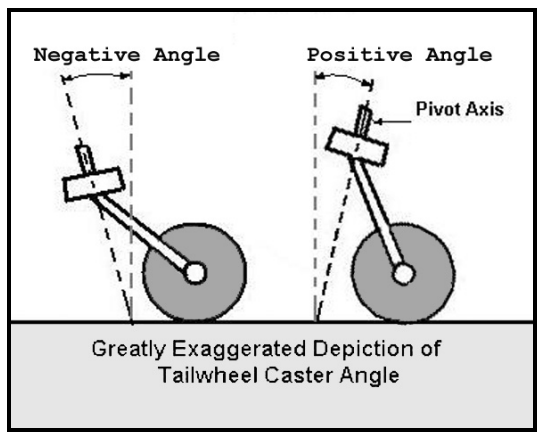
Anyway, a negative caster angle will tend to increase shimmy, and a worn assembly or unbalanced tire will make the shimmy much worse. A positive angle will reduce or eliminate shimmy and can improve the behavior of a worn tailwheel assy. If the coil-over spring on the tail shock assembly loses full temper and becomes a bit soft, it may compress too far, especially with a high aerodynamic load on the elevator. This puts the pivot post at a negative (bad) angle, and it doesn’t take much to cause shimmy. A badly worn pivot-post bearing, particularly along the fore-aft axis, can also create a neutral or negative caster angle. In either case, relaxing stick back-pressure a bit to reduce aerodynamic load can help, especially at higher speeds.
Making a new swivel bearing, re-tempering the coil spring to bring it within tolerance, having a new spring made (which a few people have done), or finding a replacement may be necessary in some cases. Adding a pair of custom-made nylon or neoprene shims can help too. This will also quiet the banging as the strut fully extends on takeoff and collapses on landing.
Whatever the cause of the problem, the goal is to have the pivot post angle at about 1.5 to 2.0 degrees positive. That may seem like an inconsequential amount but the difference is dramatic between a caster angle that is neutral or negative.
-
This reply was modified 4 years, 7 months ago by
This is not new. We have been in a “crappy place” with our L-5’s regarding tailwheel tires for most of the last 25 years. You’re lucky to have had a Stomil on your plane since you’ve owned it. Less than a dozen L-5 owners do. So, call Wings & Wheels and see what they can do for you, or talk to Desser. If you don’t like what they send you, simply return it.
The alternative is to spend $1400 on a Scott tailwheel assembly and then have Sam Taber do the required modification, which is not minor. Of all the Scott conversions (for which there is no STC), Sam’s conversion with engineering by Paul Draper (of Rousch Racing) to get the geometry correct is the best out there.
The Piper Cub owners club looked into getting expander tubes made a few years ago (same company in TX I think) and the cost was prohibitive, even with an RFQ for 100 sets. With the Carl Baker Company gone (the last commercial source of tubes, pucks and clips I was aware of), a run of expander tubes wouldn’t help in the long run even if the price was reasonable. If an expander tube leaks, the pucks are pretty much useless when they get brake fluid on them. Groves or Clevelands are the way to go if within an owner’s budget.
Glad you got one that was the correct size Bill. After I had recommended Wings & Wheels as a source a few weeks ago I checked and they had none in stock so I guess they can still get them. Yes, the inner diameter is a bit tight, but it’s a sturdy tire and less expensive. I assume that you also had to grind off the anti-slip nubs on the bead so it would fit flush to the rim.
JG
Steve,
That was Darren Crouser in Indiana (L-5C owner) who had imported some Stomil “Wersja” metric tailwheel tires and tubes from Poland back in 2013. Very high quality and identical to the Goodyear 8.00 SC tires from the 1940’s-50’s except for the name on them. Same casting marks too like they had purchased the Goodyear molds. Anyway, those sold out immediately and Darren never got more of them. They were available for quite a while from Wings and Wheels but they no longer seem to keep that size in stock (205 mm x 80 mm) but you might inquire if they can still get them. They used to be commonly used on PZL Wilga, Yak 50 and some Sukhoi aerobatic airplanes but those birds all seem to have gone to the 255 x 110 mm (10″) size because the smaller size is so hard to obtain.
I can’t recommend a solid tire. First, you cannot get them in the correct size, and second, I recently did a pre-buy inspection on the one L-5 that had a solid tire custom molded to the rim (technically not a legal tire) and it now goes thumpa, thumpa, thumpa while taxiing since it has been worn out of round in the time since it was made.
So where does that leave you? Unless you can track down a Stomil the only alternative is the overpriced 8.00 SC Aero Classic sold by Desser tire. Perhaps they have a new source but the last one I bought was made in Indonesia and was of very poor quality. The tubes I bought did not fit the tailwheel hub properly either. One failed while taxiing and the other did not last 25 landings. Desser refunded my money and I ended up using tubes purchased from a farm implement company that worked much better. Perhaps the Desser tubes had sat on a shelf too long (one failed at the valve) because they don’t sell many of them.
I recommend sticking with what you have as long as you can, treating it as gently as possible. Buy a Desser for a backup if you need to but the tire and tube will set you back about $330.00 plus shipping.
Just be aware that a good bit of oil will bypass the filter as it circulates. You will not get 100% filtration so you should still change the oil every 25 hours.
That “interior green” is close if not dead-on Matt, but Stinson didn’t use the 1943 standard colors. Their finish was in accordance with the 1941 bulletin colors and they stuck with it throughout the war. The fading properties changed sometime in late 1944 indicating a chemical difference but the 1941 color spec was still used right through the end of 1945. I have numerous late war flaps still in original cotton cover that corroborate this. For what it’s worth, I also once had an unmolested frame OH’d by MCAS Cherry Point and the green they used was darker and shinier which shows that various facilities used what they had on hand regardless of the Army-Navy paint chip bulletins or the finish specs in the manuals.
-
This reply was modified 4 years, 7 months ago by
Hilly,
There is no paint code per se, but off the top of my head the Stinson Finish (SF) for the tubing specified one coat of zinc chromate top coated with 1 coat of yellow-green primer. If I remember correctly, the yellow-green finish consisted of 1 part black enamel to 10 parts zinc chromate and 10 parts thinner. The problem, of course, is that zinc chromate varied quite a bit in color. The yellow-green finish is a bit of a misnomer because it’s far more green than yellow and, as you suspect, a bit darker in tone. I don’t know if it is sold in Oz, but the Tempo brand Aviation Green Zinc Phosphate primer is pretty close.
As a caveat, I’ll have to double-check the manuals to be sure I’ve got it right but you’ll find the finish specs in the AN 01-50DB-2 Erection & Maintenance Instructions if you have a copy of that. In later post-war versions, the manual was called the Handbook of Maintenance Instructions but the specs were unchanged (I think). I’ll try to shoot some photos later today of un-adulterated wartime parts against a white background for color correction, along with some parts with a straight zinc chromate finish only. That ought to give you a pretty good reference to compare with how your frame has been painted.
One other thought – many interior parts varied in shade of “interior green” and changed over time. I’ll send pics of some variations we’ve found that range from nearly yellow to olive to a leaf green. In other words, for a more authentic look you should mix it up a bit instead of a uniform color with everything matching the frame color. That’s not correct because many parts were made and finished by sub-contractors whose paint was a little different from the others – a virtual rainbow of greens.
JG
-
This reply was modified 4 years, 7 months ago by
Try Aircraft Ignition Services (AIS) in Dallas (Previously Joe’s Aircraft Ignition). I’m pretty sure they still do harness repair since the original owner died a few years ago, but if they can’t / won’t do it they ought to know who does.
903-378-7205 / aircraftignition@yahoo.com
That is correct. It is what I tried to explain before but apparently failed to make clear. I’m glad you’ve figured it out. JG
Craig is correct which its the same answer as the second part of my last reply. Check the “Notify Me” box . Now that there are several posts here, scroll all the way down to the last message and then you will see it.
“White” cadmium plating
p.s. Many people think that when it says “Subscribe” that it means they are already subscribed to the forum. This is not the case. I should probably change it to say “Join Forum” and “Leave Forum” so it is a bit clearer but I haven’t figured out how to edit it.
-
This reply was modified 4 years, 6 months ago by
-
AuthorPosts
